

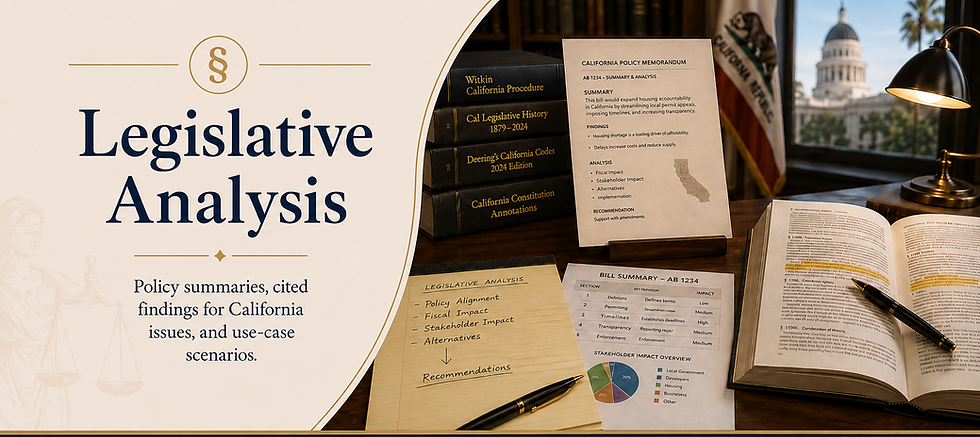
LEGISLATIVE ANALYSIS
Read the bill. Know the impact.
Legislation is written to be survived, not understood. I take California bills and policy and turn them into something you can actually act on, including what the legislature meant, not just what the text says. a plain-language summary, cited findings drawn from California sources, a clear read on who is affected and at what cost, and a recommended position. Not general commentary, but sourced analysis grounded in the codes, legislative history, and the standard California references.
Bill and Policy Summaries
Plain-language summaries of California legislation, with the key provisions and what they actually change.


Cited Findings and Research
Findings backed by California authorities, the codes, legislative history, and standard references, so the analysis is verifiable, not opinion.

Stakeholder and Fiscal Impact
A clear read on who is affected, who benefits, who bears the cost, and the fiscal implications.

Use-Case Scenarios and Recommendations
Applied scenarios and a recommended position, support, oppose, or amend, with the reasoning laid out so you can act on it.
Why it matters
Most people never read the bill. The ones who do, and who understand what it actually changes, are the ones who shape the outcome. A clear, sourced analysis is the difference between reacting to legislation and getting ahead of it.
"Real change, enduring change, happens one step at a time."
Ruth Bader Ginsburg
Frequently Asked Questions
What does a legislative analysis include?
A plain-language summary of the bill or policy, cited findings drawn from California sources, fiscal and stakeholder impact, applied use-case scenarios, and a recommended position you can act on.
What sources do you rely on?
California authorities including the codes, legislative history, and standard references such as Witkin, so findings are cited and verifiable rather than general commentary.
Can you tell me what the legislature intended, not just what the law says?
Yes, and that is often where the real value is. Reading the text is only half the work. By working through the legislative history, committee analyses, and the record behind a bill, I can show what that history indicates about the bill's purpose, the concerns behind it, and how it was meant to operate, which is frequently the question that matters most when a statute is ambiguous or contested. What that means for a particular case is counsel's call.
Who is this for?
Attorneys, advocacy organizations, and anyone who needs a clear, sourced read on a California bill or policy and its likely impact.
Do you make recommendations?
Yes. Each analysis can close with a recommended position, support, oppose, or amend, with the reasoning laid out so you can adopt it or adapt it.
Legislative analysis is research and policy support and does not constitute legal advice.